JOAN MIRO — Icon of 20th Century Modernism
Joan Miró was a Catalan-Spanish artist whose revolutionary imagination helped shape the landscape of 20th-century modernism. Born in Barcelona in 1893 to a watchmaker and a goldsmith, Miró grew up surrounded by fine craftsmanship, influencing his later surface in the delicacy, precision, and inventiveness of his work. Although he initially trained for commercial and clerical work, he soon abandoned that path to pursue art, studying at Barcelona’s Escola d’Art under Francisco Galí. By the 1910s, he was painting landscapes, portraits, and nudes that revealed early influences of Fauvism, Cubism, and Catalan folk traditions.
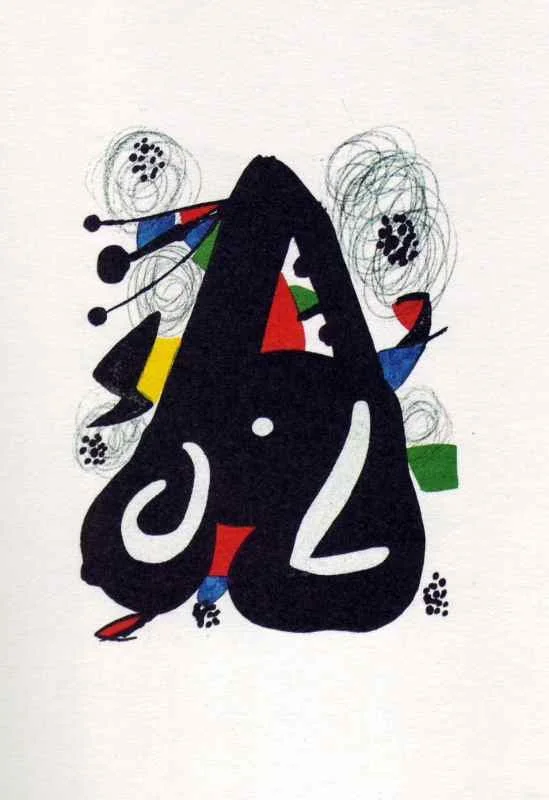
Miró’s career transformed after 1919, when he began moving between Barcelona and Paris. Immersed in the intellectual world of the Dadaists and later the Surrealists, he developed a visual language entirely his own: bold primary colors, fluid biomorphic forms, floating signs, and a poetic sensibility rooted in nature, memory, and childhood imagination. This synthesis defined the vocabulary that would make Miró one of the most recognizable artists of the modern era.
Among his early masterpieces is The Farm (1921–22), a deeply observed portrait of his family’s Catalan farmhouse. Miró famously described it as “a summary of my entire life in the countryside … the point of departure for what was to follow.” From there, he moved ever more boldly into Surrealist experimentation. Works such as Dog Barking at the Moon (1926) and his celebrated Constellations series (1940–41) showcase the dreamlike freedom, lyricism, and symbolic intensity that became hallmarks of his practice.
In the following decades, Miró expanded dramatically into new media. He created monumental sculptures, tapestries, and public works around the world. His ceramic innovations culminated in the two grand ceramic murals for the UNESCO building in Paris (1958), which earned him the Guggenheim International Award. Throughout his career, he remained an artist of continual reinvention, moving fluidly between painting, drawing, printmaking, ceramics, and sculpture, always exploring new ways to express the subconscious and the universal.


ABOUT JOAN MIRO
Miró’s work is held in every major international collection of modern art. Highlights include the National Gallery of Art (Washington, D.C.), The Museum of Modern Art (New York), the Tate Gallery (London), and the Fundació Joan Miró in Barcelona, founded with a substantial donation of works from his family. His art has been collected by prominent figures such as Ernest Hemingway, who owned The Farm, and is central to private collections such as the Nahmad Collection.
Miró continued to work prolifically until his death in 1983 at age 90. Today, his legacy endures through major retrospectives, international scholarship, and widespread museum representation.
Explore Joan Miró at DTR Modern Galleries
Miró’s work occupies a foundational position in modern art history. His instantly recognizable visual language (stars, women, birds, eyes, signs, and floating symbols) has influenced generations of artists and remains timeless in its sophistication, vitality, and joy. For collectors, Miró offers both historical significance and enduring aesthetic appeal; his paintings, prints, and sculptures are celebrated globally for their innovation, optimism, and poetic spirit. Explore and acquire works by Joan Miró across DTR Modern Galleries’ four locations in New York City, Boston, Palm Beach, and Washington, D.C.